Android Weekly is a weekly newsletter focused on the Android technical ecosystem, updated every Monday. This newsletter delves into high-quality technical content in areas such as Android system architecture, performance optimization, cross-platform development, and AI, providing continuous knowledge updates and technical insights for developers.
You can subscribe and read through platforms like WeChat Official Account, Zhihu, Juejin, personal blogs, and Zhubai.
Technical Articles
A Deep Dive into Flutter and Compose UI Rendering Refresh Diff Implementation: This article compares the diffing mechanisms of Flutter and Jetpack Compose during UI refreshes. Flutter uses a linear reconciliation algorithm to minimize lookups when updating Element configurations from Widgets. Jetpack Compose uses a
SlotTabledata structure based on a Gap Buffer, updating differences to theLayoutNodeafter recomposition is complete.Great Ideas in Computer Architecture: Virtual Memory 2 - Lecture 33: Virtual memory is a hidden but essential technology in modern computing, supporting performance, security, and flexibility. Through address mapping and paging, it provides each program with an independent virtual address space. Hardware and software collaborate to handle translation and paging, which is widely used in cloud computing, GPU compute, and databases.
Audio/Video: Analysis and Solution of Video Playback Stuttering | AV Practical Experience: This article analyzes the causes of video stuttering, such as network jitter, insufficient decoding/rendering capability, and poor buffering strategies. It proposes a layered player architecture including control, buffer management, network data, and decoding/rendering layers, focusing on a three-level buffering strategy and dynamic adjustments.
Live Recording: KMP HarmonyOS Landing Practice by Kuaishou Team | 2024 Kotlin Chinese Developer Conference: In the era of self-developed OSs like HarmonyOS, large-scale mobile app engineering faces efficiency challenges. This session shares Kuaishou’s KMP landing practice on HarmonyOS, focusing on reducing integration costs through reusable infrastructure to improve R&D efficiency.
Android 15: 16KB Page Alignment Adaptation Explained: This article explains two scenarios for 16KB page alignment in Android 15: unaligned shared libraries (
so) and hardcoded 4KB page size in native code causing syscall failures. It details the adaptation process, environment setup, and a practical example usingshadowhook.Matrix Source Code Reading Note — TracePlugin (Part 2): Analyzing the
SignalAnrTracerandFrameTracerin Matrix.SignalAnrTracermonitors ANR signals and retrieves system traces, whileFrameTracerhandles frame rate detection via API (Android 7+) or HookingChoreographer(pre-Android 7).Thoroughly Mastering Android 14 Vsync Principles: Introducing the Vsync principles in Android 14, including HW-Vsync model establishment, software Vsync signal calculation and calibration, and the request flow from Apps and SurfaceFlinger.
Android System Performance Optimization: How Many Reordering Techniques Do You Know?: Analyzing performance optimization through reordering in the Java layer (
multidex), bytecode-to-assembly (AOT/JIT), native C++ compilation, graphics stack instruction reordering, and low-level CPU/GPU machine code reordering. It also suggests that Android’s Looper message cycle could benefit from the prioritized classification found in iOS’s RunLoop.EAS (Energy-Aware Scheduling) Archaeological Logs Series, Part 5: Recording the evolution of EAS into the mainline kernel, specifically how the
schedutilgovernor was adapted for EAS (based on kernel 5.0-rc1).EAS (Energy-Aware Scheduling) Archaeological Logs Series, Part 6: Introducing the Energy Model management framework, which allows EAS to choose the most efficient CPU given performance requirements (based on kernel 5.0-rc1).
Case Study: Fast Positioning Method for Image Memory Leaks: Exploring a new method for quickly identifying memory leaks through visual analysis of image memory consumption.
Diagram of Android App Rendering Pipeline: A summary of a Google I/O 2018 talk session on the app rendering process.
Jetpack Compose Optimization Checklist: Key practices to optimize performance in Jetpack Compose, including skippability, state management, and lazy lists.
Re-learning Android - Binder Driver Loading: Detailing the initialization process of the Binder driver in the Android kernel, including
initcall, device creation, and filesystem mounting.Perfetto Advanced Usage: Compiling Browser UI: A guide for compiling the Perfetto UI locally, covering source acquisition, dependency installation, and troubleshooting common build errors.
Android 15 New Feature: Predictive Back Gesture: Explaining the predictive back gesture enabled in Android 15, which allows users to preview the interface they are returning to.
Code Naming: Avoiding Colleague Complaints: Exploring how good code naming improves readability and maintainability.
Running Large Models on Phones: Cool, Right?: Introducing the
mlc-llmproject for running LLMs directly on local devices without network dependencies, effectively improving privacy and offline interactions.Android 15 Debugging Series Part 9: Compiling Pixel Kernel Source: A guide on building the kernel for Pixel phones.
Differences between PMU and AMU: Comparing Arm’s Performance Monitoring Unit (PMU) for debugging/analysis and Activity Monitoring Unit (AMU) for system/power management.
Technical Management: Insights from Target and Object Perspectives: Discussing the core goals of tech management: supporting business success while fulfilling engineers’ professional and material needs.
Handling Android ANRs Caused by SharedPreferences: Analyzing how
apply()operations in SharedPreferences can block the main thread during activity exits, potentially leading to ANRs, and proposing a reflection-based solution to mitigate this.Audio Capabilities Series: Android Audio Part 5 — Most Comprehensive Audio Rendering Summary: Summarizing audio rendering methods on Android: AudioTrack, OpenSL, AAudio, and Oboe.
2025 Stability Business Seminar Issues: Discussing future stability improvements in memory leak detection, unresponsiveness analysis, and AI-driven automated testing.
CUDA Memory Manager: Detailing memory allocation abstraction in the CUDA driver and sharing memory between Host and Device.
Non-Technical Articles
- Glue Work: Discussing the often-undervalued “glue work” in software teams (e.g., helping others, updating roadmaps) that is essential for project success but frequently overlooked during promotions.
- Growth and Entrepreneurship Notes 6: 2025 Iterations for a Chores Mini-program.
- Vol. 28: Information Overload Survival Guide: Analyzing causes of information overload (FOMO, attention fragmentation) and proposing countermeasures like building an acquisition system.
- Why Does South Korea Always Look Like It Can’t Afford Meat?: This answer explores problem decomposition and career planning.
- Twenty Days in Xinjiang (Part 1): Snow and Sands: A 5,000km self-drive journey through Northern Xinjiang.
- Twenty Days in Xinjiang (Part 2): Song of Ice and Fire: Pursuing Silk Road relics and the Taklamakan Desert.
- Reconciliation with Parents.
- Insights from One Year of Weight Maintenance after Middle-Age Success.
- Developing “Shan He Lv Ji” to Remember Travel Footprints: An app for efficiently recording travel memories.
- How to Start a Personal Blog Elegantly?.
Motivation
On Glue Work: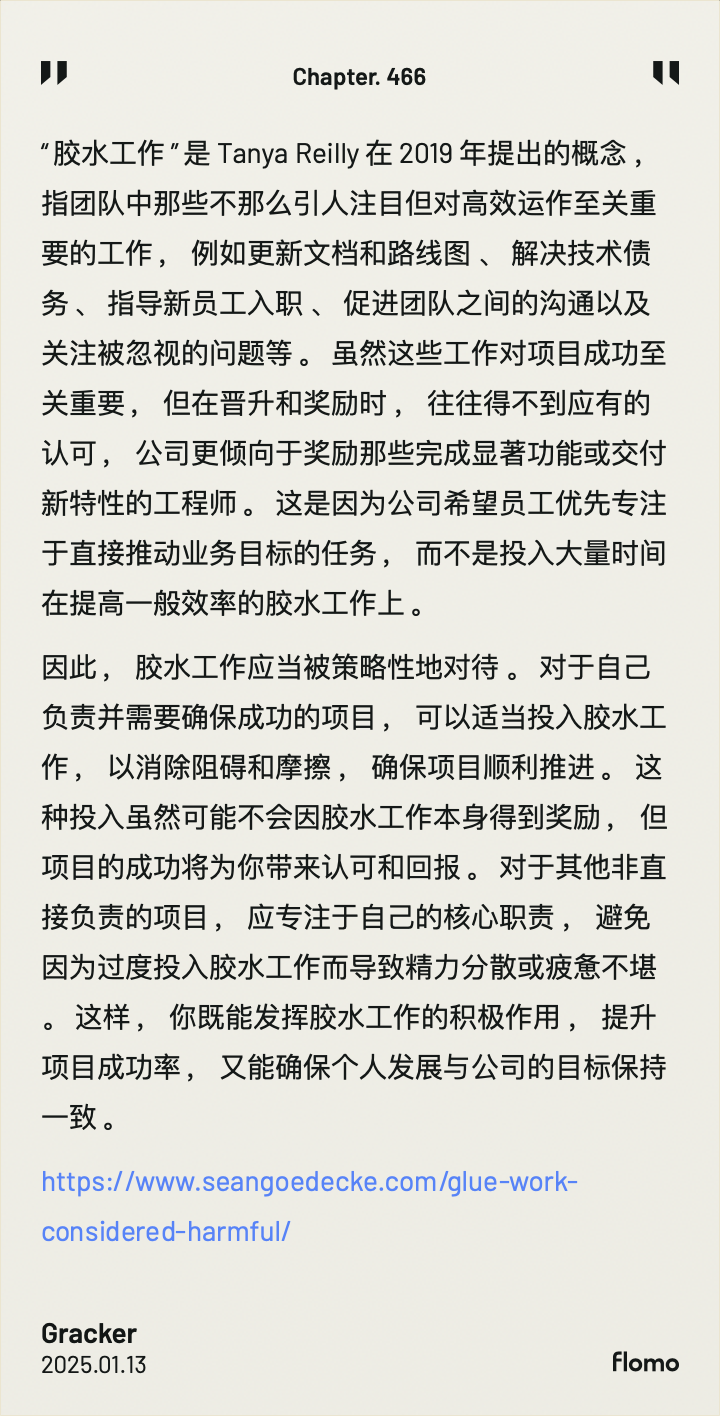
Promotion
Product analysis column by Chun Yin:
- Importance of Product Analysis: Focus on user behavior, which accurately reflects the effectiveness of product design.
- Scene Analysis: Products should match actual user scenarios and market needs.
- Product Analysis Series: Exploring various topics and market demands.

About the Author
- Juejin - Gracker
- Zhihu - Gracker
- Personal Blog - Android Performance
- About Me - Join our WeChat groups
- Curated Performance Articles
- Newsletter Subscription
- WeChat Official Account Android Performance
- Android Performance Knowledge Planet