Linked lists and arrays allow elements to be arranged in an order of our choice. However, if you want to find a specific element but have forgotten its position, you must visit every element until you find it. This can consume significant time if the collection is large. A data structure that allows for rapidly finding objects is the hash table.
HashMap is an implementation of the Map interface based on a hash table. This implementation provides all optional mapping operations and permits null values and null keys. (The HashMap class is roughly equivalent to Hashtable, except that it is unsynchronized and permits nulls.) This class makes no guarantees as to the order of the map; in particular, it does not guarantee that the order will remain constant over time.
1. HashMap Data Structure
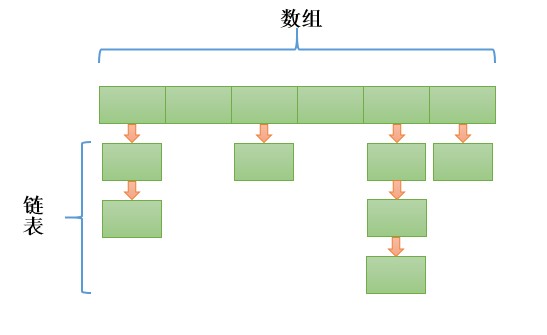
HashMap is composed of both an array and linked lists. The underlying structure is an array, where each element serves as the head of a linked list.
1 | static class Entry<K,V> implements Map.Entry<K,V> { |
Entry is a static internal class within HashMap, package-private, and implements the Map.Entry<K,V> interface. It includes a pointer to the next element in the list.
2. Constructors
HashMap has four constructors:
HashMap(): Constructs an emptyHashMapwith the default initial capacity (16) and default load factor (0.75).HashMap(int initialCapacity): Constructs an emptyHashMapwith a specified initial capacity and the default load factor (0.75).HashMap(int initialCapacity, float loadFactor): Constructs an emptyHashMapwith a specified initial capacity and load factor.HashMap(Map<? extends K,? extends V> m): Constructs a newHashMapwith the same mappings as the specifiedMap.
In essence, these boil down to two types: one where you specify initial capacity and load factor, and another that generates a new HashMap from an existing map. Let’s look at the first type:
1 | /** |
The parameters are simple: initialCapacity and loadFactor. initialCapacity defines the initial size of the array, while the product of loadFactor and capacity determines a threshold. The maximum threshold is (1 << 30) + 1. The capacity is always a power of 2, specifically the smallest power of 2 that is greater than or equal to the requested value. The default capacity is 16, and the default load factor is 0.75. When the number of elements in the map reaches or exceeds the threshold, the array capacity doubles, and elements are re-inserted into the new array. This is why HashMap does not guarantee constant ordering.
An IllegalArgumentException is thrown if the load factor is less than or equal to zero or is not a number.
3. put Operation
1 | /** |
Since HashMap allows null keys, it first checks if the key is null and performs special handling.
1 | /** |
A null key is always inserted at index 0 of the array. If an entry already exists at that position with a null key, its value is replaced; otherwise, a new entry is added. We’ll examine the addEntry function shortly.
Question: If a null key is always inserted into table[0], why do we still need to traverse the linked list?
Returning to the put function: if the key is not null, its hash value is calculated, and the indexFor function determines its position in the table.
1 | /** |
The indexFor function is brief but clever. Typically, mapping a number to a fixed length uses the modulo operator (%), i.e., h % length. However, this implementation exploits the fact that table.length is always a power of 2. In binary, a power of 2 is a 1 followed by N zeros, and (length - 1) is a sequence of N ones. A bitwise AND (&) operation is much faster and more efficient than modulo. However, this efficiency depends on length being a power of 2; otherwise, collisions would increase significantly.
This also answers the previous question. Since indexFor returns values ranging from 0 to (length - 1), it’s possible for non-null keys to also map to table[0]. Thus, we must traverse the linked list to find the exact key.
Once the index is determined, we iterate through the linked list. If the key exists, we replace the value and return the old one. modCount++ increments the modification count, which is used for the fail-fast mechanism (discussed later). If the key is not found, we call addEntry to insert a new Entry.
1 | /** |
This function takes the hash, key, value, and the bucket index. It first checks if the current size has reached the threshold AND if the bucket at the target index is not empty. If both conditions are met, resize(2 * table.length) is called. Resizing reduces collisions and maintains access efficiency. The check for an empty bucket before resizing is an optimization to delay resizing as long as possible; if the bucket is empty, adding one element won’t cause immediate performance degradation.
1 | /** |
resize first checks if the table has already reached its maximum capacity (1 << 30). If so, the threshold is set to Integer.MAX_VALUE to prevent further resizing. Otherwise, a new empty array is created with double the previous length. (Note: since capacities are powers of 2, newCapacity will correctly stay within bounds until MAXIMUM_CAPACITY is hit). The transfer function then migrates the elements.
1 | /** |
This function moves every entry from the old table to the new one. Since the array length has changed, the elements’ indices also change, which is why HashMap does not maintain ordering. Resizing is a resource-intensive operation, so it should be minimized.
Back in addEntry, after potentially resizing, a new entry is created:
1 | /** |
createEntry uses the same parameters as addEntry. Its logic is closely tied to the Entry constructor:
1 | /** |
The constructor takes an Entry object (n) and sets it as the next value for the new entry. Effectively, createEntry takes the existing list at table[bucketIndex], attaches it to the end of the new entry, and then places the new entry at the head of table[bucketIndex].
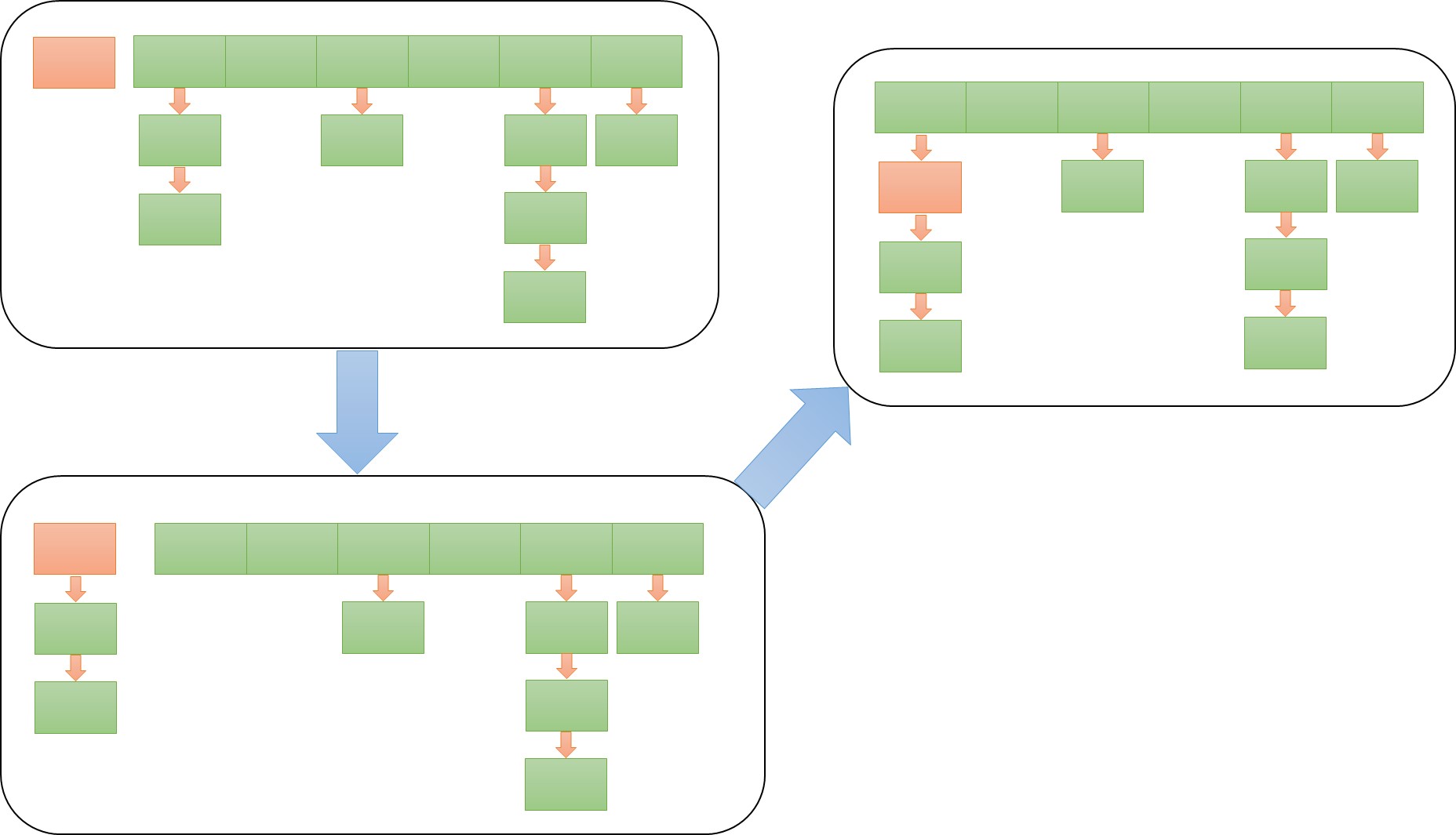
This concludes the put function. If a new key-value pair is inserted, it returns null.
4. get Operation
1 | /** |
Like put, it first handles null keys:
1 | /** |
For non-null keys, it calls getEntry:
1 | /** |
It calculates the hash, finds the bucket index, and traverses the list. It returns the Entry if found, or null otherwise.
5. Fail-Fast Mechanism
1 | /** |
java.util.HashMap is not thread-safe. If another thread modifies the map while an iterator is in use, a ConcurrentModificationException will be thrown. This is the fail-fast strategy.
This strategy is implemented using the modCount field, which ensures visibility of modifications across threads. modCount tracks the number of modifications made to the HashMap. During iterator initialization, this value is assigned to the iterator’s expectedModCount.
Note: Fail-fast behavior cannot be absolutely guaranteed. In an unsynchronized concurrent modification environment, it’s impossible to provide firm guarantees. Fail-fast iterators attempt to throw ConcurrentModificationException on a best-effort basis. Therefore, code should not rely on this exception for program correctness. Instead, fail-fast behavior should be used only to detect programming errors.
References
- Core Java
- Java API
About Me && Blog
Below are my personal details and links. I look forward to connecting and sharing knowledge with fellow developers!
- About Me: Includes my WeChat and WeChat group links.
- Blog Navigation: A guide to the content on this blog.
- Curated Android Performance Articles: A collection of must-read performance optimization articles. Self-nominations/recommendations are welcome!
- Android Performance Knowledge Planet: Join our community for more insights.
“If you want to go fast, go alone. If you want to go far, go together.”